
Overwriting Variables
Now that we’ve looked at all the background information, let’s explore how the overflows actually work. If you take a look at the overflow-1 folder, you’ll notice some C code with a binary program. Your goal is to change the value of the integer variable.

From the C code you can see that the integer variable and character buffer have been allocated next to each other - since memory is allocated in contiguous bytes, you can assume that the integer variable and character buffer are allocated next to each other.
Note: this may not always be the case. With how the compiler and stack are configured, when variables are allocated, they would need to be aligned to particular size boundaries(e.g. 8 bytes, 16 byte) to make it easier for memory allocation/deallocation. So if a 12 byte array is allocated where the stack is aligned for 16 bytes this is what the memory would look like:

the compiler would automatically add 4 bytes to ensure that the size of the variable aligns with the stack size. From the image of the stack above, we can assume that the stack frame for the main function looks like this:
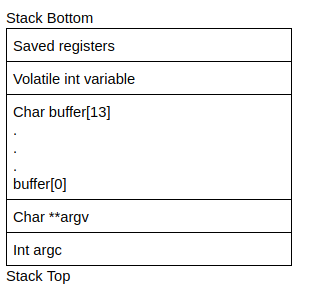
even though the stack grows downwards, when data is copied/written into the buffer, it is copied from lower to higher addresess. Depending on how data is entered into the buffer, it means that it's possible to overwrite the integer variable. From the C code, you can see that the gets function is used to enter data into the buffer from standard input. The gets function is dangerous because it doesn't really have a length check - This would mean that you can enter more than 14 bytes of data, which would then overwrite the integer variable.
Try run the C program in this folder to overwrite the above variable!
No comments to display
No comments to display